
 Sunday greeted us with temperatures in the 80s, and as I lit up my tiny Smoky Joe to smoke some pork belly, I thought with amazement about how just a couple of months ago snow was howling sideways down this very street, complete with lightning and ridiculously huge accumulation. So, clearly, everyone in Chicago was in love with this first really warm day; people were finally smiling on the street, cars weren't honking except for those friendly, short little "thank you for letting me in" honks, and yours truly was gearing up for the Salon featuring pork. Specifically, a lovely bit of pig from my friend over at X-Marx, who had just finished butchering a whole pig for his highly recommended head-to-tail dinner tomorrow night. For the Salon, we'd be working with belly, hock, shoulder, tail, flank and skin.
 We started with the flank, a tiny little cut suitable for a quick grill, aiming to make Matambre de Cerdo, an Argentinian dish based on Matambre, a stuffed and rolled beef flank steak. Cerdo means pig, and in this version, nothing gets stuffed or rolled--just salt and pepper, then a hot, smoky grill. I've read differing accounts--that matambre, translated, means "shoe leather"; another story is that the word is a mash up of the words "matar" (to kill) and hambre (hunger). Who can say which story is legit, but my intention was to use it as the latter: a quick bite to satiate the hungry pack who showed up to the Salon. So, we made tortillas, hand pressed and cooked on a slick cast iron skillet, and a chimichurri, with parsley, cilantro, marjoram, garlic, lemon, lime, a tomatillo, vinegar and plenty of olive oil. In place of the ubiquitous iceberg lettuce so seemingly beloved in South America, I used a crisp asparagus lettuce tip, very similar to romaine lettuce in texture but a bit more flavorful. Grilled that flank, chopped it up and into the warm tortillas it went, topped with the lettuce and chimichurri.
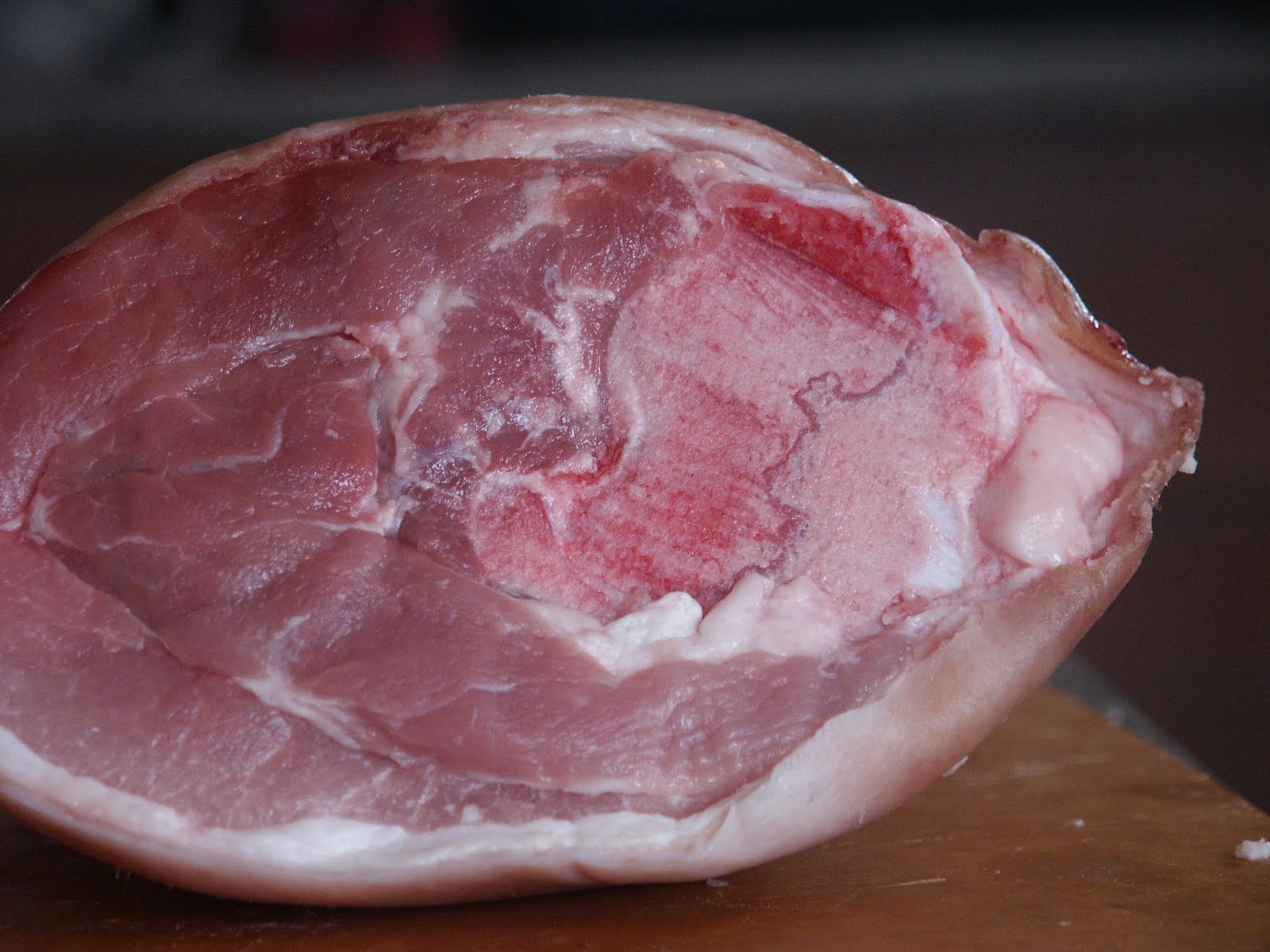 Hock Before Braising
Then we wanted to make rillettes, so we moved on to the hock; I'd braised this overnight with thyme and garlic so it was soft and fell right off the bone. There was a good bit of flavorful liquid left from the braise, which turned into a nice pork jelly as the hock cooled in it. We picked the meat, minced a shallot, and beat it with some mustard, vinegar, and lard rendered earlier in the day. Plenty of salt and pepper, a touch of the pork jelly, and we packed it into a little pot. Served it as a spread of sorts with some epi bread I'd made and the pork belly jam we'd make next.
 Hock After Braising
For the belly jam, I did a quick cure, just overnight (as opposed to the several day cure bacon gets), with brown sugar, salt, star anise, fennel seed, black pepper, ajowan and cumin. Took it out in the morning, rinsed it, patted it dry and placed it on a rack in the fridge to dry out as much as possible in order to get the important pellicle formation--that dry, somewhat sticky outer coating of meat left uncovered in the fridge--that helps the meat absorb smoke. This usally takes more time as well, but hey--the Salon was that day so we did what we could. I then smoked it for a few hours on said Smoky Joe with some hickory chips; it got nice and smoky, and deliciously crisp on the outside. It was all I could do not to eat it all right when it came off the grill. So, when the time came, we cut it into little chunks, and fried them in lard in a pot, sort of mashing them around as we went, letting them crisp up, then we deglazed with red wine, red wine vinegar, and threw in some blueberries and mango and a bit of sugar. This cooked down for a bit, the berries popped, and we had ourselves a real nice, smoky yet bright accompaniment for the bread and rillettes.
 I just had to pull out that salty Bentons ham as well, so we cubed it up, fried it in that lovely lard, then added big wedges of red onion. Got these nice and charred, deglazed with sherry vinegar, drizzled in plenty of olive oil, and tossed it all with adult spinach. Baby spinach has less flavor, costs more, and would just wilt immediately; the adult spinach kept a nice in between of wilting and staying crisp. This decadent salad was intended to be served with a garnish of pork rinds, but hey--we were drinking beer and just plain forgot. But the pork rinds would be made. Oh yes, they would be.
I cleaned the skin of the pig as much as possible, removing fat and meat. Then I boiled it for a few hours, the heat removing any fat I missed and breaking down the tough protein; then I used the back of a knife to scrape it clean again and put it in a low, low oven to dehydrate it more overnight. I then repeated the process all over again, making these guys really, really dry and tough. We heated canola oil to around 350 degrees or so, then threw the chunks of skin in; they puffed up light and crisp in seconds; we tossed them with bacon salt, a mixture not containing any bacon, but lots of salt and smoked spices that emulate bacon. Crispy, crunchy, oh so porky.
To finish, we whipped egg yolks and maple syrup into a sabayon--a light, foamy mousse of sorts--then folded in whipped cream, crispy bacon we'd cooked earlier and the fat that rendered out of it. Gave it a light freeze, then gobbled it all up--a nice little bacon semi-fredo.
It was a great Sunday afternoon that turned into evening that turned into night; we discussed food, the south, and demented haunted houses. I got to meet some new interesting friends, and we all ate copious amounts of food. This was a happy incarnation of the Salon, and I look forward to many more. Which reminds me--I was at a benefit last night at Kith and Kin in Chicago and ran into someone who attended the Seafood Salon by the oyster bar (where I spent much of the night parked). She proudly declared that she'd been eating the oysters bare, and chewing them, ever since the Salon. I beamed, and happily ate another with her.


